When early tests raise the possibility of cancer, more detailed investigations are often needed to understand exactly what is happening. There may be a period of uncertainty between the first abnormal finding and receiving a confirmed diagnosis, and additional tests may be recommended to clarify your results.
Once the additional tests are completed, the findings generally lead to one of the following outcomes:
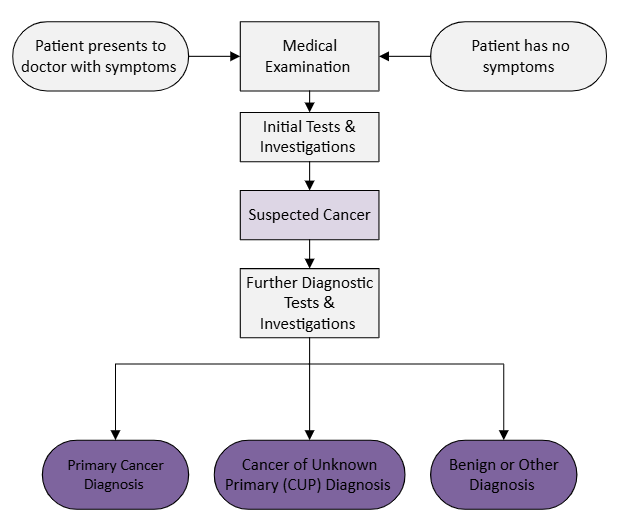
Further testing may show that the initial concern is not cancer.
What happens then?
In most situations, no cancer-related treatment is needed. Ongoing monitoring or routine follow-up may be recommended depending on the specific findings, but no further cancer investigations are required.
The cancer may have a clear starting point. The site that a cancer originates from is referred to as a primary site. This type of diagnosis is referred to as a primary cancer diagnosis. For example, breast cancer is a primary cancer that originates from tissue in the breast.
In some cases, further investigations may indicate that a cancer is present but has spread from the initial primary site to other areas of the body. When this occurs, the cancer is referred to as metastatic, a term that describes the spread of cancer from its primary site.
If the metastatic cancer has a confirmed or suspected primary site, it may be diagnosed as a metastatic primary cancer- for example, breast cancer that has spread to other organs of the body is called metastatic breast cancer.
If the primary origin of a metastatic cancer cannot be identified despite initial tests and investigations, further investigation is needed to determine whether a primary site may be found, or whether the cancer’s primary site is unidentifiable, at which point it will be classified as a confirmed Cancer of Unknown Primary (CUP).
Here are the links to other information pages to learn more about different aspects of the diagnostic journey. You may also use the quick links on the right side of the page to navigate.

Investigations for a suspected cancer can lead to various diagnostic outcomes. To learn more about the different types of diagnosis, click here.